He was a close friend who had spent years losing ground to an opioid dependency that started with a workplace accident. The usual story, or what became the usual story. By the time they decided to try ibogaine, he had been cycling through the system for years and had nothing left to show for it.
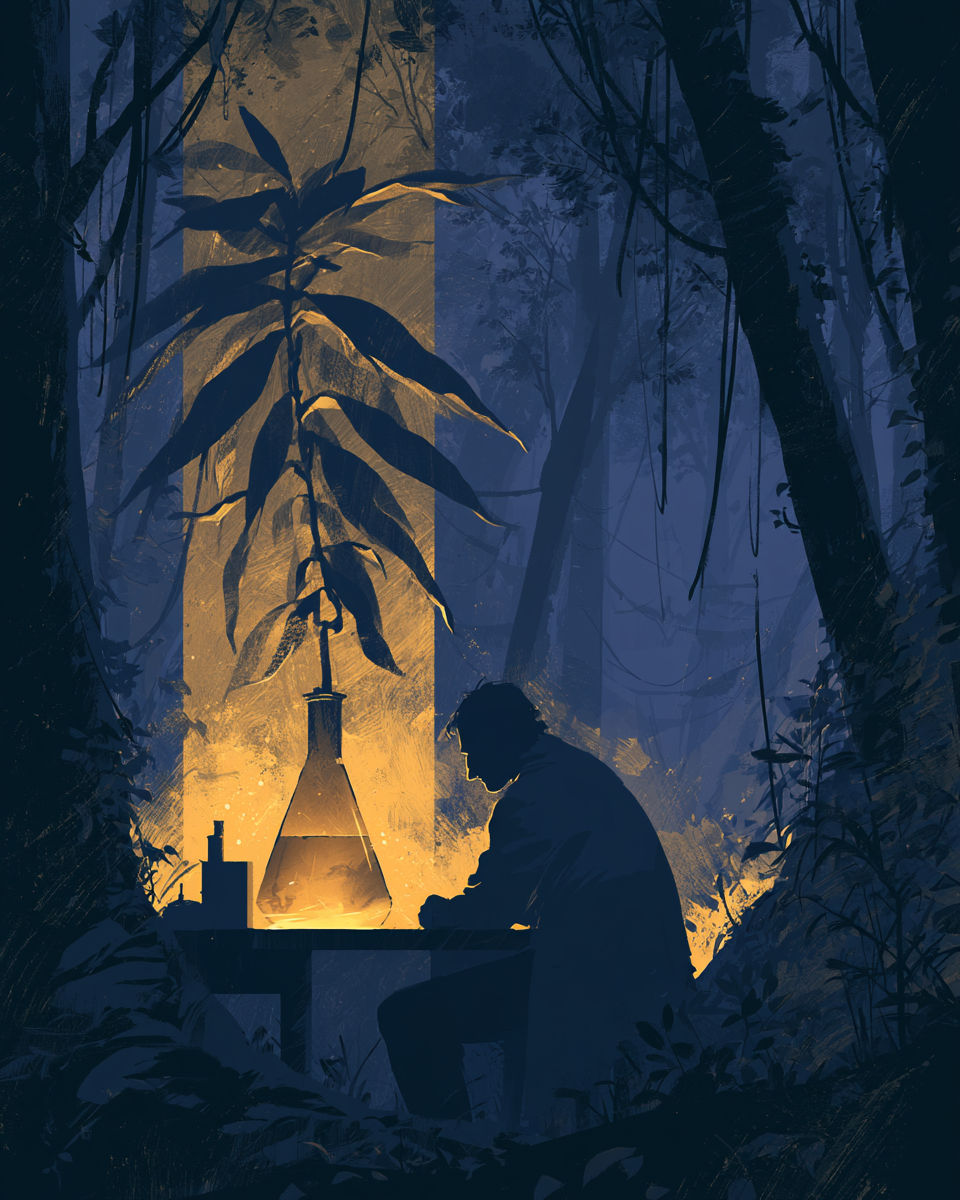
Three young men had set up a laboratory in a rented commercial space in a Canadian city. They had no formal chemistry training. They had taught themselves, using research papers and mail-order equipment and trial and error. The capital came from cryptocurrency. He had bought early, when most people around him were still treating it as a joke, and the bet had turned into something far larger than he expected. He had spent a few years traveling the world on it. He had no fixed obligations, no career, no particular plan. Eventually he came back, and the money went into the lab. The goal was earnest: supply ibogaine extracts to the Canadian clinics trying to treat exactly the kind of addiction that had been eating their community for years. The friend would be their first patient.
He died thirty-six hours after his session. Not from a cardiac event, which is ibogaine's documented and most discussed risk. He fell in the shower during the recovery window, and the fall caused a cerebral hemorrhage that proved unsurvivable. The company dissolved. Two of the three partners moved on.
The third came back to the lab after the funeral. He stood in that space, surrounded by medicine he had spent months learning to make, trying to figure out what came next.
He didn't leave.
Somewhere in western Canada, a self-taught chemist has spent the past decade building what is arguably the most reliable ibogaine supply chain outside of Gabon. He processes raw root bark in batches of ten to thirty kilograms. He runs it through two extraction stages he developed and refined over years of practice and adjusts the alkaloid profile of each batch based on direct feedback from the practitioners he supplies. He maintains what he believes to be the largest private database of iboga sample analyses in existence. If you have received ibogaine treatment at a reputable clinic in North America or Latin America, there is a meaningful probability that his extracts were part of your session. He has no chemistry degree, no professional credentials, no website, and no public profile. You have almost certainly never heard of him. That's how he wants it.
He heard about ibogaine the way a lot of people hear about ibogaine: through a friend who heard it somewhere else, and somewhere in the chain there was Joe Rogan's voice. This was 2013. He was in his mid-twenties, sitting on a small fortune from a cryptocurrency bet he had made a few years earlier when virtually nobody was paying attention. He had spent part of that windfall traveling the world. He had seen a lot. He had come back to a community that was quietly being destroyed by a prescription drug epidemic that the institutions responsible for handling it were nowhere near handling.
"They're killing my friends," he told me. "They're killing people. So what am I going to do about that?"
The laboratory took shape over the following months. The three men had no formal training in what they were attempting. They had research papers, chemical suppliers, and the particular urgency of watching people around them fail out of every available treatment. He funded it. The money that had come from staring at a computer screen at the right moment now went into frosted windows and chemistry equipment and months of trial and error, all of it in service of figuring out something the medical system had decided wasn't worth figuring out. They were going to turn raw iboga root bark into a usable medicine and get it to people who needed it.
Standing in the Lab
The friend's death collapsed everything they had built. The company dissolved. The other partners moved on.
He came back.
"I come back to the lab," he said, "and I'm like standing in this place with all of this medicine around me." He paused, the way someone pauses when the scene they're describing is still in the room with them. "And I'm thinking: what do we do with this?"
What went wrong, as he spent the next decade working to understand, was not primarily the ibogaine. It was the dosing. The alkaloid profile. The absence of any reliable framework for calibrating an experience that could range from mildly psychoactive to physically destabilizing depending on variables that even experienced providers were guessing at.
"I realized that no one was going to be able to figure out the dosing with this," he said. "And if no one was going to do it, I had to."
He became, over the years that followed, an advocate for something the mainstream ibogaine world had been slow to embrace: low-dose protocols. Not microdosing in the wellness-culture sense, but deliberate, calibrated sub-flood administration targeted at specific conditions. Fentanyl detox. Treatment-resistant depression. Neurological decline, including Parkinson's disease. The reasoning was practical rather than philosophical. Ibogaine's most significant barrier to formal clinical use has always been its cardiac risk profile. That risk is dose-dependent. If the therapeutic mechanism could be engaged at a fraction of a full flood dose, the equation changed.
He has now administered low-dose protocols to patients with Parkinson's on thirteen occasions, tracking outcomes informally over years. In roughly 30 percent of cases, he observed meaningful improvement in tremor severity. No published clinical trial has looked at this specific question. He has been looking at it from a house in the Canadian woods, one patient at a time, for over a decade.
The Work
The operation today is neither glamorous nor small.
He receives raw root bark from Gabon, the West African nation that is the primary habitat of the iboga plant and the home of the Bwiti tradition, the ceremonial framework within which iboga has been used for centuries. Shipments arrive two to four times per year, ten to thirty kilograms at a time. He processes each into two products: total alkaloid extract, which preserves the full spectrum of the plant's active compounds, and purified total alkaloid, which is more concentrated and more precisely dosed.
The five primary alkaloids in iboga (ibogaine, noribogaine, ibogamine, ibogaline, and a category he calls residual alkaloids) do not occur in fixed ratios. They vary significantly depending on where the plant was grown, which variety it is, and how it was harvested. This is not a minor technical detail. It is the central fact about ibogaine that the clinical literature, which tends to treat the compound as though it were uniform, has largely failed to grapple with.
The bark from Gabon is not the same as the bark from Cameroon. He has a name for a particular Cameroonian variety based on its distinctive profile; it behaves differently under extraction and delivers a different experience. Not subtly. Fundamentally different. Think about it the way wine people think about appellation and terroir: the same grape variety, grown in Burgundy versus Bordeaux, produces wines that are chemically and experientially distinct in ways that have nothing to do with the winemaker's technique. The soil, the climate, the local genetics all leave their mark in the glass. Nobody disputes this about wine. In ibogaine, the same logic applies and almost nobody is applying it. Providers who have spent years working with one regional source and then switch, without understanding what changed, are in some meaningful sense giving their patients a different medicine. Most of them don't know it. The formal literature doesn't acknowledge it, because nobody has done a proper genetic taxonomy of iboga varieties across Africa. He has been pointing this out for years to people who have mostly not wanted to hear it.
What a patient experiences is not determined solely by the dose. It is determined by which alkaloids are present, in what ratios, from which plant, from which part of Africa, processed how. Ibogamine affects the emotional texture of the experience in ways distinct from ibogaine's primary pharmacological action. Residual alkaloids alter the overall quality in ways he can demonstrate by adding them back to an extract processed without them. He adjusts for all of this, batch by batch, based on feedback from the practitioners he supplies. There is no formal framework for any of it. He built the framework himself.
He tests every batch himself. Every extraction he runs, he tastes, and in some cases takes, to verify what he made. This is not a quality control method you would find in any pharmaceutical GMP document. It is the kind of method you develop when you've been doing something for ten years that no institution was doing, and the consequences of getting it wrong have always been yours to carry.
Over that decade he has accumulated and anonymized analytical data from a wide range of iboga sources, building a comparative map of the plant's chemistry that no commercial entity or academic institution has assembled. Different labs use different analytical methods (mass spectrometry, IR spectroscopy, HNMR) and the results are snapshots: what was in a given sample at a given moment from a given origin. He is one of the very few people who has been taking those snapshots systematically, from the same sources over time, and comparing them to each other. The result is something close to a field guide to iboga variance: which origins run high in ibogamine, which carry more residual alkaloids, which ones behave unexpectedly under the same extraction protocol.
This is, in the current state of the ibogaine industry, the closest thing to a quality standard that exists. There are no regulatory requirements for what "ibogaine" means when a clinic lists it as a treatment. A facility can administer semi-synthetic ibogaine, whole-plant total alkaloid extract, or purified total alkaloid from any of a dozen different sources and call all of it ibogaine treatment. Patients have no way to know what they're getting. Most providers cannot tell them with any precision. He can.
What the Plant Is Not
The industry's growing interest in semi-synthetic ibogaine has not impressed him.
The semi-synthetic route starts with Voacanga africana, a West African tree that contains a chemical precursor convertible to ibogaine through a relatively straightforward synthesis. The appeal is obvious: no root bark imports from Gabon, no complications around African bioresource agreements, potentially lower cost per gram. Several companies are building supply chains around this approach and marketing it as the sustainable, scalable future of ibogaine.
He has a few problems with this. The first is practical: the synthesis generates significant chemical waste, and Voacanga africana is still a tree that has to be cut. The sustainability argument assumes the problem is iboga overharvesting, but iboga is not going extinct. It grows in Mexico, Costa Rica, in homes like his across the world. The challenge is a supply chain problem, not a botanical extinction problem, and it does not require swapping one African tree for another while adding acetone to the process.
His deeper objection is about the medicine. Semi-synthetic ibogaine is ibogaine: a single isolated molecule, stripped of the four other primary alkaloids and the residual alkaloid fraction that make up the whole plant's chemistry. He has run experiments adding residual alkaloids back to semi-synthetic ibogaine. The extract changes. Providers who have worked with both describe the difference. He does not think this is preference or placebo. He thinks the whole plant has something the isolated molecule does not, and that the pharmaceutical industry's habit of treating ibogaine-the-compound as equivalent to ibogaine-the-treatment is going to cause real problems as the field scales up and nobody doing the regulatory paperwork cares about the difference anymore.
He is in contact with iboga-producing communities in Africa regularly. He has spent time in southern and eastern Africa (the cryptocurrency money that did not go into the lab went into travel, and the travel shaped the work as much as the chemistry did) and is working toward a trip to West Africa, to Gabon, to the Bwiti heartland. He grows ten iboga plants at home.
His answer to the sustainability problem is not Voacanga. It is cultivation. He is involved in early-stage research into bioreactor production of ibogaine alkaloids: hairy root culture and tissue culture derived from live iboga plants, grown in an industrial fermenter. The theory is that you take root tissue from an actual iboga plant, maintain it in a controlled environment, and produce the full alkaloid spectrum without waiting fifteen years for a tree. A 2,000-liter reactor, run correctly, could in principle outproduce dozens of mature trees. The research is early and unproven at commercial scale. He is not certain it will work. But he is more interested in finding out than in defending a supply chain built around a different plant and a chemical synthesis. If the world is going to need a new source of iboga alkaloids, he thinks it should at least start from iboga.
"They're killing my friends. They're killing people. So what am I going to do about that?"
He has a pricing rule: if you have $70 or $100, he will work with you to make sure you have access to the medicine. "That's my promise to people," he said. This is not a marketing position. It reflects a particular view of what his role in the supply chain actually is. The chain runs from African communities that have held this knowledge across generations, through global distributors and processors like him, to the practitioners and patients at the end. Nobody invented iboga. The appropriate relationship to it is custodial. The pricing reflects that.
When he processes a batch, he keeps his phone away. He describes this as ceremony, not in any mystical sense, but in the sense of work that asks for full attention and returns something when it receives it. "The medicine has always been that North Star for me," he said, "through a lot of rough moments." There have been a lot of rough moments.
A Different Kind of Impossible
Canada's relationship with ibogaine looks, on paper, more permissive than the United States'. Ibogaine is not scheduled under the Canadian Controlled Drugs and Substances Act. It has never been placed in a schedule comparable to the American Schedule I classification that has been ibogaine's primary regulatory barrier in the US system for decades.
In practice, this turns out to mean very little.
"Health Canada," he explained, "they've made it illegal without essentially making it illegal in scheduling. They've made it effectively impossible for physicians, doctors, or anybody with a medical license to use it in their treatment of a person, because it's considered a scheduled three drug. And if you're working with a doctor and they find out that that doctor is working to prescribe for clients that are going through ibogaine treatment, your license is gone."
Schedule 3 in Canada means a prescription drug. A prescription drug requires a GMP-compliant pharmaceutical supply chain. No such supply chain exists for ibogaine in Canada. A doctor who wanted to prescribe it legally would need a product that cannot be purchased legally, from a manufacturer that does not exist, at a dosing standard that has never been formally established. Canada, despite never criminalizing ibogaine in the way the United States did, has effectively erected the same barriers to legitimate clinical use by a different bureaucratic mechanism. The result looks the same from the inside.
What this means for him is that the supply chain he has built over ten years exists in the same legal gray zone in Canada that it occupies everywhere else. He built it anyway. He keeps building it.
He is also watching what happens next in the United States with something between interest and wariness. The American moment, the clinical trials and the executive orders and the Texas research funding, is going to change the scale of this thing in ways that the informal networks that built it were not designed to accommodate. A pharmaceutical company that successfully patents a refined ibogaine compound has every incentive to ensure that the people who have been providing it for decades are reclassified as competitors. He has no public profile. There is no media about him anywhere. "Not by accident," he said.
And yet people find him. They always have, through word of mouth, through the providers he has worked with for years, through the quiet infrastructure of a world that runs on trust rather than certification. He receives inquiries from people who are out of options, who need medicine they cannot access through official channels. He works with most of them.