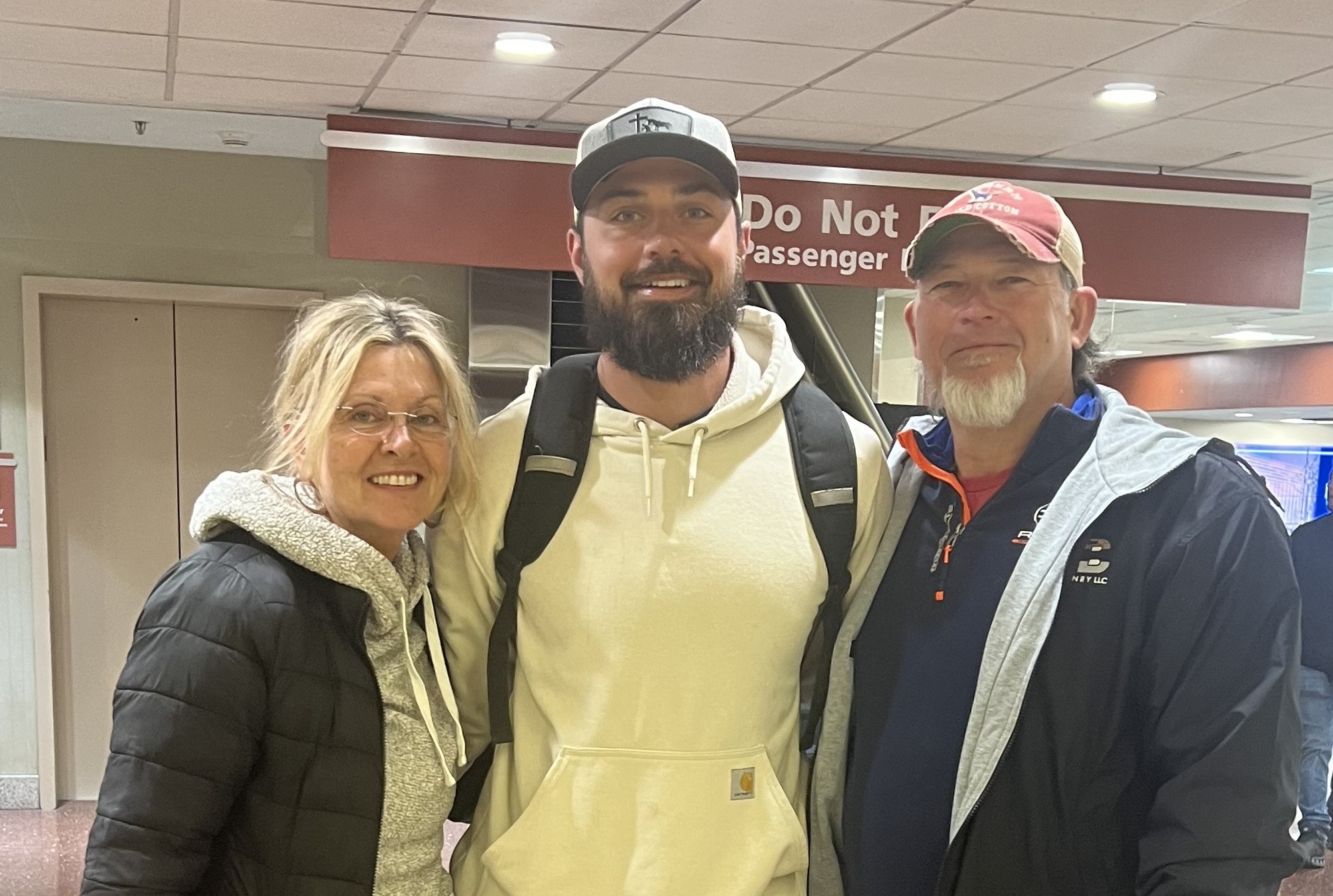
By the end of a decade in addiction, Diane Hall and her husband Tom had quietly begun preparing for the worst. They had talked it through. They were, in her words, coming to terms with what they believed was around the corner. Their son Chase had been through roughly seven rehabs. Nothing had worked. Nothing was working. So they did what parents in that position eventually do. They began to brace.
Diane and Tom raised Chase in Kentucky, where Diane had already paid more than her share to addiction. Two of her three brothers had died of overdose. She knew addiction ran in the family, and she was willing to do anything to keep Chase from the same fate. I spoke with her for about an hour about how she navigated Chase's decade of worsening addiction. Most stories like Diane's don't end the way hers did. This is the story of how a desperate family found ibogaine and what the search felt like. This is Diane's story.
A decade losing her son
Diane describes Chase before addiction as the love of the family's life: a gifted athlete, a star in football and basketball through middle and high school, a kid who never had to study and still earned straight A's, with college coaches looking at him. "He's just a unique child," she told me. "We had so much fun with Chase growing up."
She believes his popularity was part of his undoing. It started, as she tells it, with marijuana and then pills. He went to Morehead State University to play football, was injured before he could play, and "once he went away to college, things just went south."
What followed was about ten years: roughly seven rehabs and sober living houses across Kentucky, Florida, California, and Missouri. "None of them worked," Diane said. "And he knew it." A rehab in his home state failed inside 24 hours, because "all they've got to do is call and get somebody to pick them up." There was jail, there were attorneys, there was the impossible question of whether to bail him out or let him "learn his lesson." She didn't want him to become a hardened criminal. "I just, it's hard."
Addiction had already taken a brutal toll on her family. Two of Diane's three brothers died of overdose. Her parents died within four months of each other in the same stretch. They didn't die of overdose, but the back-to-back loss was devastating in its own way. "My main focus in life was to make sure this didn't happen to my child," she said. "We're going to go to church, we're going to talk about drugs, all the things. And it still happened."
She brought those losses up deliberately. Slowly losing Chase had been more painful than all four of them combined, she told me later. I believe her.
Some people just give up on their kids and just let them go because it's so emotionally taxing and they don't have the strength for the journey. I felt like that some days. But I love him too much to ever give up on him. I will fight for his life as long as he has air in his lungs.Diane Hall
She is direct about the cost of every small intervention. More than once she drove through the night when word came that Chase was in trouble, to go get him herself. Each rescue, she believes, bought time: "all of those little things, I think, kept him alive."
And by the end, she and Tom were bracing for the worst. "Me and Tom had talked," she said. "We're going to come to terms with this, because we know what's coming and what's around the corner." Chase was strong-willed and nothing was working. Quietly, they had begun thinking about a funeral they prayed they would never have to plan. As Diane put it: "If something big in his life didn't change, and we tried all the things, we were going to lose him."
The glimpse of hope
The turn came from a podcast. Diane and Tom were watching the Joe Rogan Experience, the episode with Rick Perry and W. Bryan Hubbard. Hubbard described "this plant medicine from Gabon, Africa," and the idea that it could reset the brain so a person is no longer addicted and doesn't go through withdrawals.
"We just kind of looked at each other," Diane said, "like we have a glimpse of hope for the first time." She was guarded even so: "Maybe it works for them, but our child, he's one of the hard cases. I don't know if it's going to work for him. But it's all we had."
The search became a daily obsession. She got off Facebook ("you don't want to see everybody's happiness") and opened an Instagram account for the sole purpose of researching ibogaine. "I don't think there was a day that went by that I didn't Google, Instagram, YouTube something about ibogaine."
She also frames the find spiritually. "I know ibogaine was what reset his brain and got our son back. But I know God led us to ibogaine." When I offered that her years of prayer had worked, just not on her timeline, she answered: "Exactly. Exactly."
The cold message that worked
The decisive moment was a long shot. Searching Instagram, Diane came across Chase Rowan, a veteran active with Americans for Ibogaine. "I was like, this is a long shot," she said. "But I don't care, I'm going to reach out to him anyway."
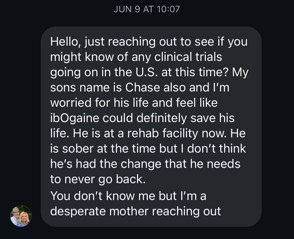
Chase Rowan messaged her back immediately and told her to call him. He was at the state capitol that week, a few days before the ibogaine bill passed, and hundreds of messages were coming in. Hers, he told me later, was the one he felt pulled to answer.
I will get your son to the medicine. Don't you worry.Chase Rowan, to Diane
Chase Rowan didn't stop at the call. He pointed Diane to Iboga Treatment Center and made the introduction himself. She now had the name of a clinic. She still had to decide if it was the right one.
Choosing the clinic
Diane looked hard at other clinics, and she was candid about why Iboga Treatment Center ended up being the choice. Two factors decided it: detox capability and timing.
Chase was using 7-OH (7-hydroxymitragynine) heavily at the end, and he was not detoxed when he needed to travel. Diane had heard Bryan Hubbard say a patient must be off all medication for five days or a week before treatment. "That wasn't going to be a possibility," she said. She had looked hard at the better-known clinics, Beond and Ambio Life Sciences, but did not know whether they would have handled the detox Chase still needed. What she did know was that Iboga Treatment Center would: it "specialized in the 7-OH that Chase was on at the end," and would take Chase and finish the detox in Mexico.
Timing decided the rest. Diane said Iboga Treatment Center was flexible on timing: they were willing to work with whenever she could get Chase there. Her read on the larger clinics is that they schedule months in advance, and she doubted they would have had the flexibility to handle a patient as unstable as Chase. "Definitely grateful for Iboga Treatment Center, because they made it happen. I don't know that it would have been scheduled anywhere else."
There was also a failed earlier attempt that shaped her caution. She had once spent about $10,000 sending Chase to a provider in Florida, "a new person starting up," who flooded Chase on iboga root bark rather than purified ibogaine. It didn't work.
The fears going in
I asked what scared her most. She was worried about the cardiac risk, but Chase was young, big, and physically healthy apart from the drugs, so it didn't terrify her.
What frightened her more was Mexico itself. "I've never been to Mexico. I was worrying about the cartels." By the time the decision came down, though, that picture had softened. She had come to believe parts of Los Angeles were more dangerous than the part of Mexico she was sending Chase to; the cartel image in her head did not match the place he was actually going. Chase Rowan also promised her Chase would leave the clinic with "a whole new family." Diane: "And he did."
And underneath all of it, the deepest fear: "the fear of it not working for him. Nothing else had worked. So I did have that fear of him going down there, doing that, coming back home, and relapsing yet again."
Getting him there
The logistics were, in Diane's word, awful.
Chase was too unstable to travel alone. Tom flew with him from home to Denver, walked him to the connecting gate, watched him board the flight to San Diego, and then flew straight back home. Chase "was such a mess, he knew he might not make it from one terminal to the other." Even then, Chase initially said he couldn't do it. The family talked him onto the plane.
The detox bridge that got him stable enough to fly is its own striking detail. Chase used his father's hydrocodone to come partly off 7-OH. Tom had become dependent on hydrocodone years earlier, after knee surgery and over-prescription. In a coincidence Diane calls "crazy," Tom and Chase effectively detoxed at the same time: Chase tapered on Tom's remaining hydrocodone to get to Mexico, and Tom came off the pills in the same stretch. The clinic coached Diane through supports for the trip, including vitamin C powder and medication for the pain of withdrawal.
I shared a parallel from my own treatment, my wife and daughter struggling to get themselves to Mexico, because it underlines the same point Diane kept making: getting a loved one, and the family, physically there is its own ordeal. "It's a process," she said. "It's not easy. You do need the right people."
Mexico, in his words
Chase was at Iboga Treatment Center from November 18 to December 5, 2025. Diane could not be in Mexico with him. Neither could Tom, who had handed Chase off at the airport in Denver, nor Chase's fiancée Emilee, back home in Kentucky. So most of what Diane knows about the treatment itself came through his texts.
Earlier that day, Diane had texted him encouragement about putting in the work and starting over with a blank piece of paper. Chase wrote back: "You're right. I wanna stay out here as long as I can. I wish they would let me work for the retreat." He had been in Mexico less than 24 hours. The medicine was still ahead of him.
By evening the texts had turned vulnerable in a way Diane had never seen from him. "I'm super nervous about tonight," he wrote her. Diane wrote back what amounts to a prayer text: "Be all in with open arms and let the healing that you've been seeking for so long begin." A short while later, ninety minutes from the start: "I'm so nervous. It's starting in 2 hours and I'm scared to death for some reason."
He had arrived still in withdrawal and spent his first day on IV fluids and vitamins. The clinic treated the residual withdrawal with medication and stopped it the morning of the flood. The worst of it lifted during the flood itself.
The first time Chase reached out after the ibogaine flood was on November 20. "Thank you so much for doing this for me. I love you mom," he wrote. Then the visions. "I saw Dad clear as day at the very beginning of it. It freaked me out so bad I had to take the eye patch off." He described seeing the hair on his father's arms. And, a moment later: "I saw you and Emilee too." A visitation of the family he had been on his way to losing.
The Bufo session
A few days after the ibogaine flood, Chase did a separate Bufo session. Bufo, also called 5-MeO-DMT, is a short-acting psychedelic distinct from ibogaine; most Mexico ibogaine programs offer it as an optional, integrative second medicine a day or two after the flood. The two experiences are not the same medicine and they are not the same kind of journey.
Chase texted Diane about his on November 22. She had asked whether God had come to him in any of his visions.