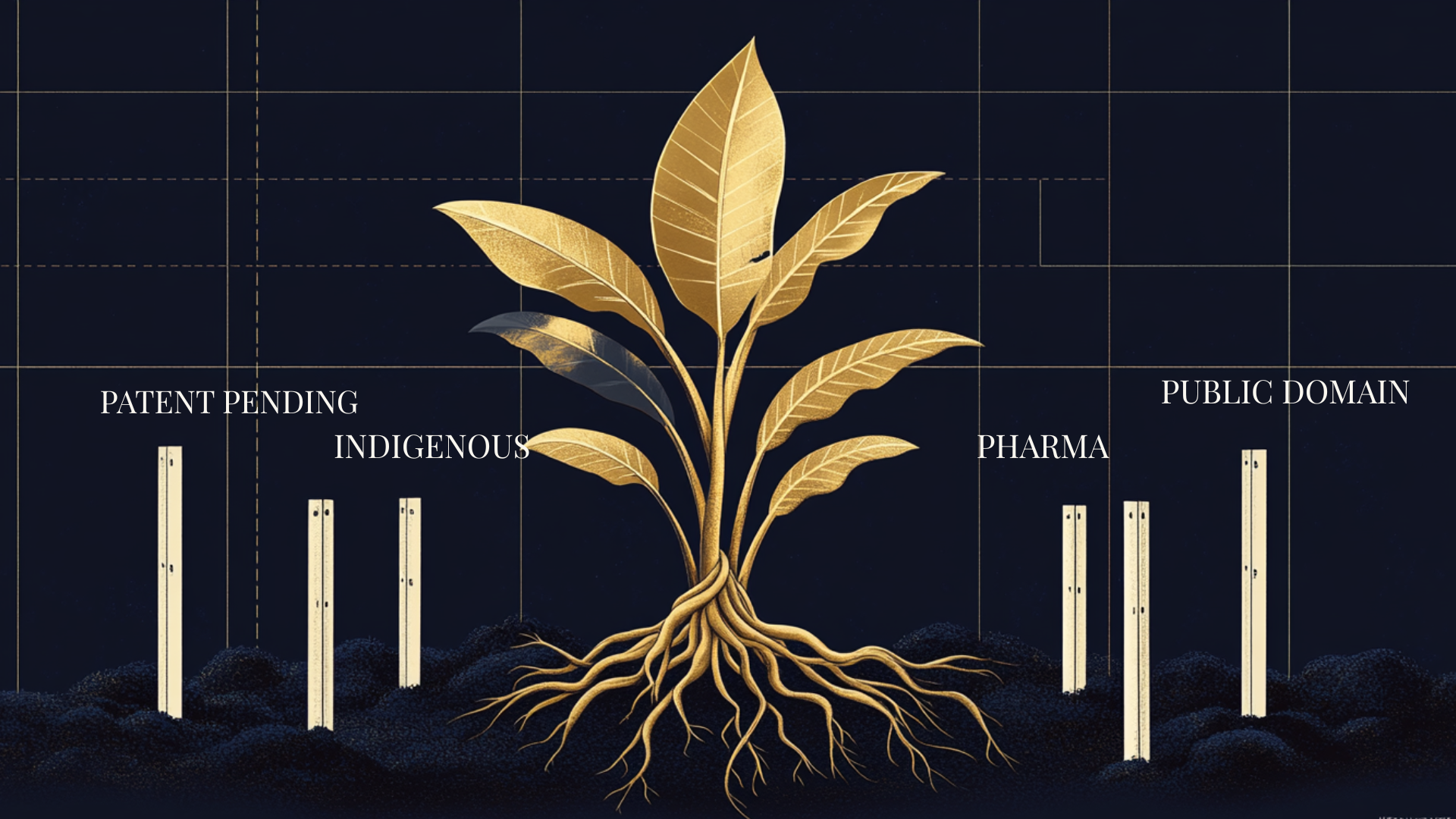
The pharmaceutical arrival
Gilgamesh Pharmaceuticals received a $14 million grant from the National Institute on Drug Abuse in 2024 to develop GM-3009, a synthetic ibogaine analog specifically engineered to remove the cardiac risk. GM-3009 was expected to enter Phase I clinical trials in 2026. Tabernanthalog (TBG), developed at UC Davis, is designed to eliminate the cardiac risk altogether by removing interactions with the cardiac ion channel responsible for QT prolongation.
The case for this work is not cynical. Ibogaine has a real cardiac problem. It blocks hERG potassium channels in cardiac muscle cells, which delays the heart's electrical reset and can, in a patient with an underlying susceptibility or an undisclosed drug interaction, trigger a fatal arrhythmia. In a well-run Mexico clinic with proper cardiac screening, magnesium co-administration, and continuous monitoring, that risk is manageable. In a US outpatient setting across a wide range of clinical environments, the calculation is different. A synthetic analog with no QT prolongation could make the medicine accessible to people who can't get to Mexico and can't access the level of clinical care that makes the natural molecule safe.
Several practitioners and researchers I've spoken with (people who want ibogaine to succeed) have told me privately they don't believe the natural molecule clears the FDA on the cardiac question, full stop. Not because the risk can't be managed in a careful clinical setting, but because the FDA doesn't approve drugs for the most careful clinicians. It approves them for general use, across the full range of environments and practitioners who will eventually administer them. That distinction matters, and it's the argument the analog developers are walking into.
That matters. And it matters enough that the argument for pharmaceutical development of ibogaine analogs is serious, not just expedient.
But pharmaceutical development also means patents. It means IP on the modified molecules, on the delivery mechanisms, on the dosing protocols. And here is the problem with the entire analog approach that rarely gets stated plainly: nobody has a complete mechanistic account of why ibogaine produces the outcomes it produces. We have theories: opioid receptor reset, GDNF release in the ventral tegmental area, disruption of addiction-encoded circuitry, something involving noribogaine's long half-life and its own receptor activity. But we do not have a coherent mechanistic story that explains why the outcomes are as durable and as profound as they are.
That matters enormously for what the analog developers are attempting. Their approach assumes the cardiac profile and the therapeutic profile are separable: that you can engineer out the QT prolongation and leave the healing intact. That assumption might be right. But it has no mechanistic foundation, because the mechanistic foundation doesn't exist yet. You can't claim to have preserved what you don't understand. The molecule-removal approach is, at its core, an educated guess about which parts of the compound are doing which jobs. If the guess is wrong, you'll find out in trials. You might also find out after approval, in a less controlled way.
For a pharmaceutical company, the calculus is straightforward: you believe the cardiac and therapeutic profiles are separable, you file the patent, you run the trial. The practitioners who've spent years watching the natural molecule work (without being able to fully explain why) tend to see that bet differently. And the trials, when they come back, will answer the efficacy question. The ownership question gets settled long before the results do.
The model that almost worked
Back to Hubbard. What makes the Kentucky story worth knowing is that he wasn't proposing a standard pharmaceutical licensing arrangement.
The model was structured differently. Kentucky's opioid settlement funds, $42 million, 5% of the state's total, would be committed to a public-private partnership. A drug developer would match that investment and assume all legal, logistical, and financial risks associated with securing FDA approval for clinical research into ibogaine's application to opioid use disorder and any other condition where it demonstrated efficacy. In exchange, that drug developer would anchor its R&D to Kentucky. Two developers had committed. Philanthropic capital from Jurvetson, Cohen, and Etheridge was lined up alongside. The state would have had a genuine stake in the shape of what came next.
It wasn't a perfect model. It had political dependencies that turned out to be fatal. But it was a real attempt to ensure the public had structural leverage over a medicine being developed largely on observational data that the public had paid for indirectly, through ruined lives, through opioid settlement funds, through decades of ignored addiction suffering.
The new Attorney General killed it. The two anonymous drug developers who had committed to Kentucky are unaccounted for. Hubbard regrouped with the REID Foundation, now called the American Ibogaine Initiative, a private philanthropic organization. Different structure, different leverage, different accountability to the public interest.
Three years later, Kentucky returned to ibogaine. State lawmakers passed SB 77, which creates an ibogaine research and IP fund administered by the Department of Agriculture and allows partnering with a drug developer. Governor Beshear (the same governor whose 2023 re-election enabled the AG who pushed Hubbard out) vetoed it. His stated reason was pointed: "This raises the concern that this legislation is meant to pay a specific company." The legislature overrode him 31-6 in the Senate and 77-18 in the House. Who the specific company is hasn't surfaced publicly. But if Beshear's accusation is accurate, SB 77 is the exact inversion of what Hubbard built: state money structured to underwrite private IP capture, pushed through over a governor's objection. Two vetoes, opposite models, same state, same governor. Both overridden.
The race taking shape
Kentucky turns out to be the exception, not the template. Across the country, three distinct ownership models are now competing to define what ibogaine becomes.
The first is the state-led public research model, anchored in Texas. Texas originally structured its $50 million for a public-private partnership with specific conditions: any drug company partner had to match the state's investment, establish corporate presence in Texas, and commit 20% of future drug revenue back to the state. Multiple pharmaceutical companies submitted proposals. None met the terms. In March 2026, Texas announced it was proceeding through a university consortium (UTHealth Houston and the University of Texas Medical Branch at Galveston) with no pharmaceutical partner, committing the full $50 million to publicly managed trials. Mississippi structured its own bill to explicitly align with the Texas consortium. Oklahoma, Tennessee, and Missouri have similar legislation pending. This is becoming a multi-state public research bloc, and if it holds, the FDA approval pathway it generates would be owned by state universities rather than a private company.
The second model is Colorado's, and it is structurally the most different. Colorado is not trying to run ibogaine through the FDA drug pipeline at all. House Bill 26-1325, passed in May 2026, establishes up to five ibogaine research pilot sites within the state's existing natural medicine framework, the same regulatory structure that already governs licensed psilocybin centers. The law takes effect August 12, 2026. It is funded by grants and donations rather than a state appropriation, which is a vulnerability. But it contains one provision no other state has included: any entity cultivating, manufacturing, dispensing, or administering ibogaine under the program must establish a benefit-sharing plan with Indigenous communities. Colorado is the only state that has written the Nagoya principle directly into its statute. That matters for the Gabon question raised earlier, and it matters as a precedent.
The third model is the pharmaceutical pipeline running in parallel to all of this. Gilgamesh's GM-3009 was expected to enter Phase I trials in 2026, backed by $14 million from the National Institute on Drug Abuse. These programs don't need state money or state permission. They are running their own trials, on their own timelines, toward their own IP.
Compass Pathways is not a cautionary tale about what might happen to ibogaine. It's already happened, one molecule over.
Compass synthesized psilocybin into a specific crystal structure (Polymorph A) and patented it. Then came the international patent applications covering dozens of mental health conditions far beyond depression, and most notoriously, claims on the therapy room itself: soft furniture, muted colors, a couch or bed, a high-resolution sound system. The community pushback was real. Tim Ferriss, David Bronner of Dr. Bronner's (who called it "monopolistic and shady"), and others went public with it. A nonprofit called Freedom to Operate challenged two patents at the Patent Trial and Appeal Board and lost: the board declined to invalidate the claims, though it defined Polymorph A so narrowly that Compass's ownership is limited to that exact crystal structure. The set-and-setting claims were withdrawn from the original challenged application in 2022. But a separate pending application filed under Compass Pathfinder Limited (US20250302851A1) contains the same language: soft furniture, muted colors, eye masks, headphones, even a playlist "that mirrors the pharmacodynamics of a typical high-dose psilocybin session." It was not a retreat. It was a refile. Compass kept most of what it came for.
COMP360 hit primary endpoints in two consecutive Phase 3 trials for treatment-resistant depression, in June 2025 and February 2026. An NDA submission is targeted for Q4 2026. If it clears, the company that tried to patent a couch owns the regulatory narrative for an entire medicine class.
The ibogaine version of this story writes itself. The one meaningful difference is that ibogaine's cardiac profile makes the synthetic analog route not just commercially attractive but nearly required for FDA approval at scale. That makes the Compass outcome the default future for ibogaine, not one possible scenario among several, unless the Texas public university model gets there first with competing data.
Before drawing the obvious conclusion that the public-benefit alternative is better: MAPS tried that approach with MDMA, using a nonprofit structure, a non-patentable molecule, and explicit public benefit framing. The FDA rejected MDMA-assisted therapy in 2024 on trial design and misconduct concerns. The public-interest path has its own failure modes, and they are not hypothetical.
The question the field has not yet answered is which of these models reaches FDA-quality clinical data first, because whoever gets there first shapes the regulatory pathway for everyone else.